Why Are Lights Blinding Me at Night? Halos and Glare Explained
For many drivers over the age of 40, the evening commute has shifted from a routine journey into a high-stress gauntlet. What used to be a clear road ahead is now a disorienting landscape of “starburst” headlights, shimmering streetlamps, and a persistent, blinding haze.
If you find yourself gripping the steering wheel tighter or squinting at oncoming traffic, you aren’t just “getting older”—you are experiencing a physiological shift in how your eyes process light. At The SEE Clinic, we frequently hear patients ask: “Why are lights blinding me at night?” Understanding the relationship between glare and halos at night driving is the first step toward regaining your freedom on the road and protecting your long-term ocular health.
The Anatomy of Night Vision Problems
To understand why your vision is changing, we first need to distinguish between the two most common complaints: glare and halos.
What is Glare?
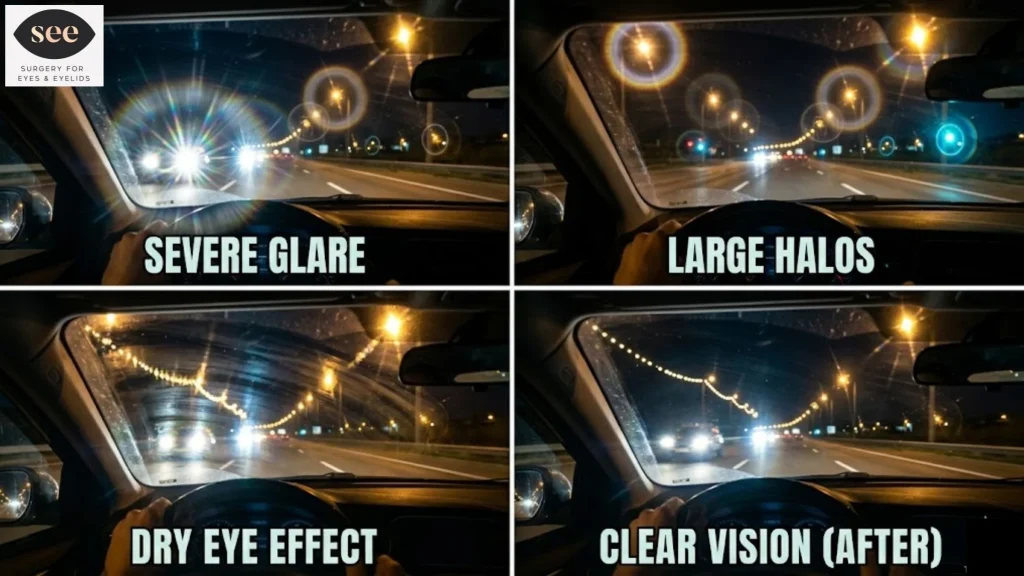
Glare occurs when light enters the eye and interferes with your ability to see a clear image. It creates a “veiling” effect, much like looking through a dusty windshield. This sensation of being “blinded” by high-beam LEDs is often a sign of increased light sensitivity eye causes.
What are Halos?
A halos vision problem is slightly different. Halos are the glowing rings or circles that appear to surround a light source, such as a streetlight or a brake light. These rings indicate that light is being scattered before it reaches the back of your eye, preventing it from focusing on a single point.
Why Is This Happening? Common Causes for Drivers 40+
While there are several reasons for night vision decline, they generally fall into three categories: structural changes, surface issues, and the natural aging process.
1. Cataracts: The Primary Trigger
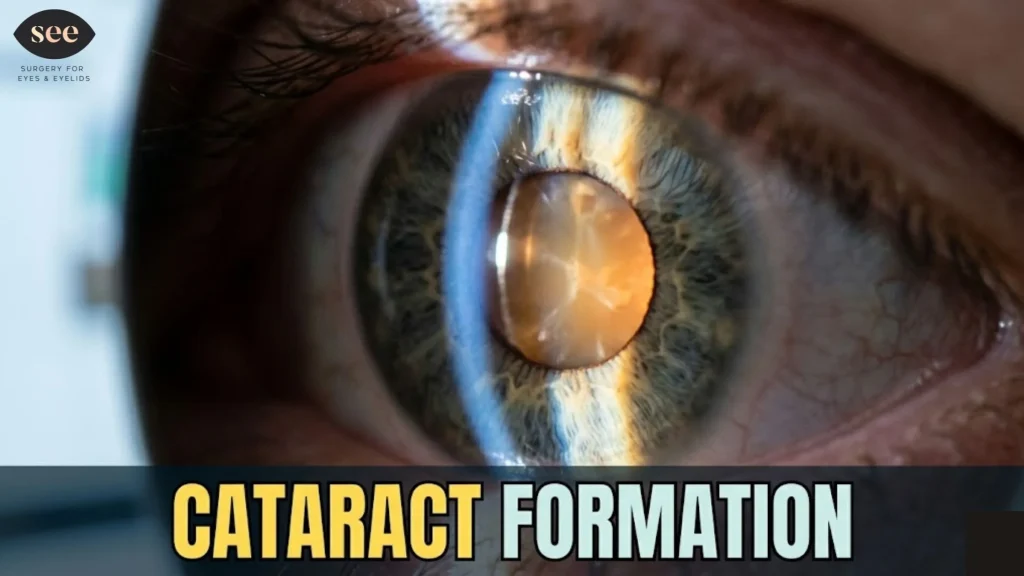
For the majority of drivers over 40, the most likely culprit is the development of cataracts. A cataract isn’t a film over the eye, but rather a gradual lens clouding inside the eye itself.
The lens of your eye is mostly made of water and protein. As we age, those proteins begin to clump together. Think of your lens like a clear window: a cataract is like that window becoming frosted or fogged up. When light from a car headlight hits this “frosted” lens, it doesn’t pass through cleanly. Instead, it hits the protein clumps and scatters in every direction. This is why cataract night driving becomes so dangerous; the scattered light creates massive starbursts that can hide pedestrians, road signs, or lane markings.
2. Astigmatism and Refractive Errors
If your cornea (the clear front surface of your eye) is shaped more like a rugby ball than a football, you have astigmatism. This irregular shape bends light unevenly. During the day, your pupil is small, which helps mask these imperfections. At night, however, your pupil dilates to let in more light. This wider “aperture” allows light to hit the more irregular edges of the cornea, magnifying the appearance of streaks and halos.
3. Dry Eye Syndrome
It might seem minor, but the quality of your tear film is essential for clear vision. An uneven or “bumpy” tear film creates a rough surface on the eye. Just like a scratched camera lens, a dry eye surface scatters light, causing a shimmering glare that makes it difficult to focus on the road ahead.
The Impact of Modern Car Technology
Ironically, as car safety technology has improved, night driving has become more difficult for those with sensitive eyes. Modern LED and High-Intensity Discharge (HID) headlights emit a “cooler,” bluer light compared to the warm yellow of older halogen bulbs. While these provide better illumination for the driver of that car, the blue light spectrum is much more likely to cause significant glare for oncoming drivers, especially those experiencing early lens clouding.
How to Tell if it’s Time for a Consultation
If you are nodding along to these descriptions, you might be wondering if your symptoms require medical intervention. Ask yourself the following:
Do I avoid driving at night? If you’ve started making excuses to stay home after dark, your vision is already impacting your quality of life.
Is cleaning my windshield ineffective? Many drivers mistakenly think their car is the problem, only to realize the “fog” is inside their eye.
Do colors look dimmer? Early cataracts often act like a yellow or brown filter, making everything look slightly “sepia-toned.”
Has my prescription changed frequently? Rapid changes in your glasses prescription can be a byproduct of a thickening lens.
Solutions: From Simple Fixes to Permanent Restoration
At The SEE Clinic, we believe that no one should have to give up their independence because of treatable vision problems. Depending on the root cause of your glare, several solutions are available:
Professional Lens Coatings
If your glare is caused by mild astigmatism or standard aging, high-quality anti-reflective (AR) coatings on your spectacles can make a world of difference. These coatings are designed to allow more light to pass through the lens while minimizing the internal reflections that cause halos.
Managing the Ocular Surface
If dry eye is the culprit, a targeted treatment plan involving specialized drops or “punctal plugs” can smooth out the surface of the eye, significantly reducing light scatter.
Cataract Surgery: The Gold Standard
If cataract night driving has become impossible, surgery is often the best—and only—permanent solution. Modern cataract surgery is a precise, quick procedure where the cloudy natural lens is removed and replaced with a clear, synthetic Intraocular Lens (IOL).
The results are often transformative. Patients frequently report that not only is the glare gone, but the world looks brighter and sharper than it has in decades. Advanced IOL options can even correct astigmatism or provide multifocal vision, potentially reducing your reliance on glasses altogether.
Safety Tips for Navigating the Night
While you wait for your appointment at eyesandeyelids.co.uk, use these tips to stay safe:
Look to the left: When a car with bright headlights approaches, look toward the left-hand edge of your lane (the “fog line”) rather than directly at the lights.
Keep it clean: Ensure your windshield—both inside and out—is spotless. A thin film of dust on the interior glass can turn minor glare into a blinding haze.
Dim your dashboard: Bright lights inside the car cause your pupils to constrict, making it harder to see the dark road outside. Dim your dashboard lights to the lowest comfortable setting.
Don't Let the Lights Blind You
Vision changes after 40 are common, but they are not something you have to live with. Whether you are dealing with early-stage lens clouding or a simple refractive error, the experts at The SEE Clinic are here to help you see the road ahead with clarity.
Ready to reclaim your night vision? Visit eyesandeyelids.co.ukto book a comprehensive assessment. Our specialists provide tailored care to address your specific symptoms, ensuring you can drive safely and confidently, no matter the time of day.
FAQ: Quick Hits on Night Vision
Is glare a sign of a stroke or emergency?
Generally, no. Glare and halos are usually chronic, progressive issues related to the lens or cornea. However, if you experience a sudden loss of vision or see flashes of light and new floaters, contact an eye professional immediately.
Can "Night Driving Glasses" with yellow lenses help?
Actually, most ophthalmologists advise against them. While they might feel like they reduce glare, they achieve this by blocking light—meaning you are actually seeing less of the road in already dark conditions. A clear lens with a high-quality anti-reflective coating is always a better choice.